SALTT Solns.

Category: About SALTT

  • The GROOVE Family

    SALTT is positioned in a class hierarchy of applications and has its own specific purpose in organising ideas around focus management and salience alignment training.
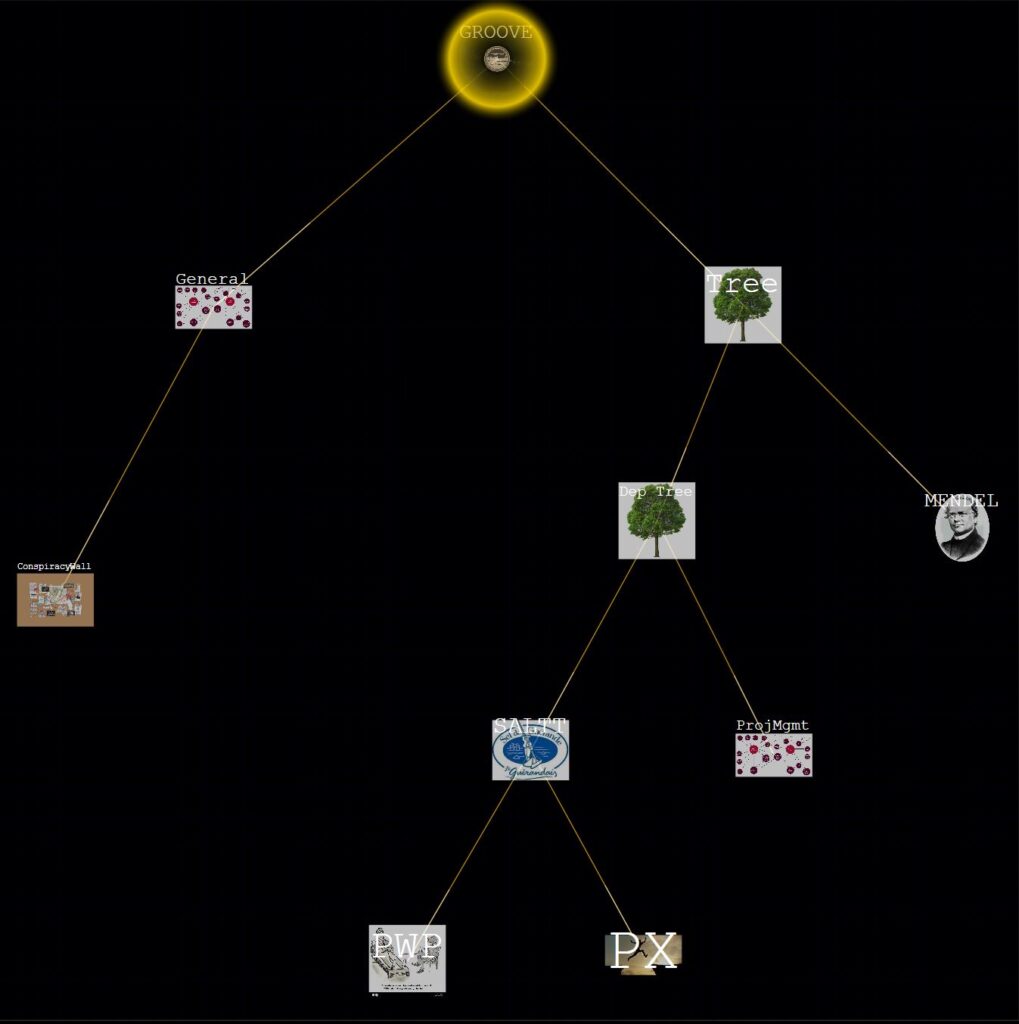
    Not all of the classes in the hierarchy are depicted nor will be released, but if they are, may be given more meaningful names, and other classes are likely to be added. Parsing the path down from the most general application class, the notable classes are.

    • GROOVE: Graph Relation Object Oriented Visual Environment is a general class: a visual environment for handling graph theoretical constructs using object oriented principles.
    • General: allows for graphs that are not specific to tree structures and supports loops and symmetric relationships.
    • Conspiracy Wall: is for modelling social relationships between people and pragmatic relationships between concepts. It is so named after a common trope seen on cop programmes.
    • Tree: handles general tree structures.
    • Dep. Tree. handles tree structures specifically relating to hierarchical dependencies (the above diagram is an example).
    • ProjMgmt.
    • SALTT: Salience Alignment Training Technology is about training the habits of identifying what is personally important and arranging action in that direction. SALTT moves the individual from languishing to flourishing and can be remedial at one end, while more self-guided generative learning at the other.
    • PWP is intended for Psychological Well-being Practitioners to guide their clients into finding what is important and motivating to them. It is intended to be used alongside remedial psychotherapy for common mental health conditions.
    • PX is intended for generative development of Personal Excellence. Rather than being about mental conditions, it is about becoming world class at a meaningful endeavor.

  • The SALTT Path

    Ok, I’ve never read the novel nor seen the film and probably never will. I’m calling this blog the SALTT Path. The first bit it rather obvious, but the term “path” is something from the mathematics of graph theory upon which SALTT is based.

    As with blogs, my proposed ambitions are high, but I am sure they will settle down eventually. The purpose of this blog is that of a mind dump as the ideas occur, then tidy them up, organise them, and put them into the main pages.

    SALTT is intended to be used a little like a digital drawing package and preserves a lot of the conventions, but for a more specific purpose of visualising, prioritising, and arranging ideas: it is a canvas. But like any other canvas, it needs the artist to know what they are going to do with it. The user guide can only show how the tools operate. These tools just bring fairly much established methodology up to date using digital platforms and human interactivity. They facilitate the methodology but don’t determine it; and it is that underlying thinking behind the use of SALTT that needs conveying – what to use SALTT for.

    The SALTT Path, then as a blog, is here to present how this modern digital platform is applied to time served ancient wisdom.

    The beachhead market for SALTT is that of Psychological Wellbeing Practitioners (PWPs). As SALTT offers a means of organising ideas, PWPs can guide thier clients into recognising what is personally important thereby assisting behavioural change. But as a way of organising ideas, SALTT has more general “off-label” applicability.

    SALTT was not orignially intended to be for project management specifically; there are many project management packages already available. However, experimentation has shown that SALTT is amenable to managing projects in a more visual way. These “off-label” applications will also be explored in this SALTT Path blog.